Be Human Culture and Practice Programme
Choice and Control are key policy agendas but are our systems culturally ready to embrace and achieve it?
We need to move away from “Them & us” to “all of us”
The Be Human Culture & Practice Programme is a comprehensive organisational development initiative designed to embed the 7 Be Human principles into culture, systems and everyday practice:
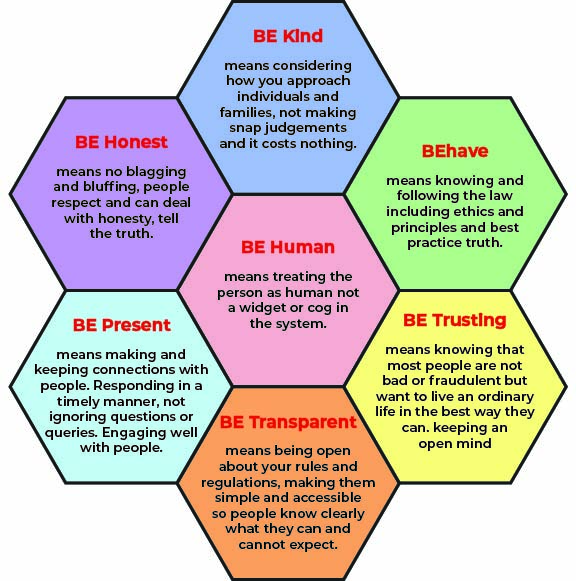
Be Human • Be Kind • Be Honest • Be Trusting • Be Present • Be Transparent • Behave
The programme combines:
- public recognition and commitment to Be Human
- a feedback loop from people who draw on support and from employees
- culture assessment
can include:
- a range of training and development
- process & policy re-design
- dispute resolution
- advice and mentoring
Programme Purpose
To help organisations adopt the Be Human principles in a way that:
- transforms organisational culture
- improves relationships and trust
- simplifies processes
- strengthens ethical and compassionate practice
- improves outcomes for people who need support, their families and staff
- ensures people are treated with dignity, respect and humanity
This includes supporting both internal culture change and direct support and a feedback loop to the people who rely on services/support and your employees.
The 7 Principles of Be Human
Programme Benefits
For Organisations
- Stronger culture of dignity, transparency and humanity
- Reduced complaints and faster resolution of issues
- Improved staff retention, morale and engagement
- More efficient, user-friendly processes
- Better reputation and public trust
For Staff
- Supportive, respectful workplace culture
- Less conflict and clearer communication
- Improved confidence and emotional resilience
- Alignment between organisational values and daily practice
For Individuals, Families & Self-Funders
- Clearer understanding of rights, processes and choices
- Independent support when systems feel overwhelming
- Access to mediation when relationships break down
- More humane, respectful interactions with services
- Improved outcomes and reduced stress
Programme Objectives
1. Embed the Be Human principles across all levels of the organisation.
2. Assess current culture, behaviours and systems to identify gaps.
3. Strengthen staff skills.
4. Redesign processes to be more human-centred and less bureaucratic.
5. Install accessible, safe, and transparent feedback systems.
Programme Structure
Phase 1 – Commitment & Kick-Off
Activities:
- Leadership-level briefing
- Introduction to the Be Human principles
- Staff and people who draw on support surveys
- Signing of a Be Human Commitment Charter
- Co-design of a tailored implementation plan
Outcome: Shared organisational commitment, clarity of purpose and feedback of where we are now.
Phase 2 – Culture & Practice Assessment
Activities:
- Results and analysis of feedback surveys
- Interviews and focus groups
- Process, pathway and customer-journey mapping
- Observation and document review
- Analysis of strengths, gaps and risks
Outcome: A diagnostic report with clear recommendations for embedding Be Human principles.
Phase 3 – Action
Optional core modules include:
- Human-centred communication & ethical leadership
- Systems, policy & process redesign – Removal of unnecessary bureaucracy of clearer, fairer, more accessible pathways
- Co-production with staff and people who draw on support
- Transparent feedback process for staff and people who draw on support
- Mediation & dispute resolution
- Advice & support
Outcomes: A confident, skilled workforce able to apply human-centred behaviours daily.
Review of policies, information and workflows creating systems that support humanity rather than restrict it.
Why Invest in the Be Human Programme?
Because treating people with humanity improves outcomes everywhere.
Because better relationships reduce conflict, stress and cost.
Because transparency builds trust.
Because people deserve systems that work for them, not against them.
Because culture change requires structured, committed support.
Next Steps
If you wish to proceed:
1. Exploratory Meeting (free): confirm needs and priorities
2. Agree Scope & Budget: customise the programme
3. Programme Launch: leadership kick-off, initial feedback and Be Human Commitment
Contact: Julie Stansfield ~ julie.stansfield@in-control.org.uk